Lovable is a candidate for founders, designers, and development teams starting a React-based web app from a description and handing work over through GitHub. Its preview, visual editing, and backend connections can be evaluated together.
Budget for credits and check whether an edit affects other files or database permissions. Your team remains responsible for app security. The information was checked on 1 August 2026; PickByTask has not tested the product.
Contents — jump to a section
How is Lovable different from website generator?
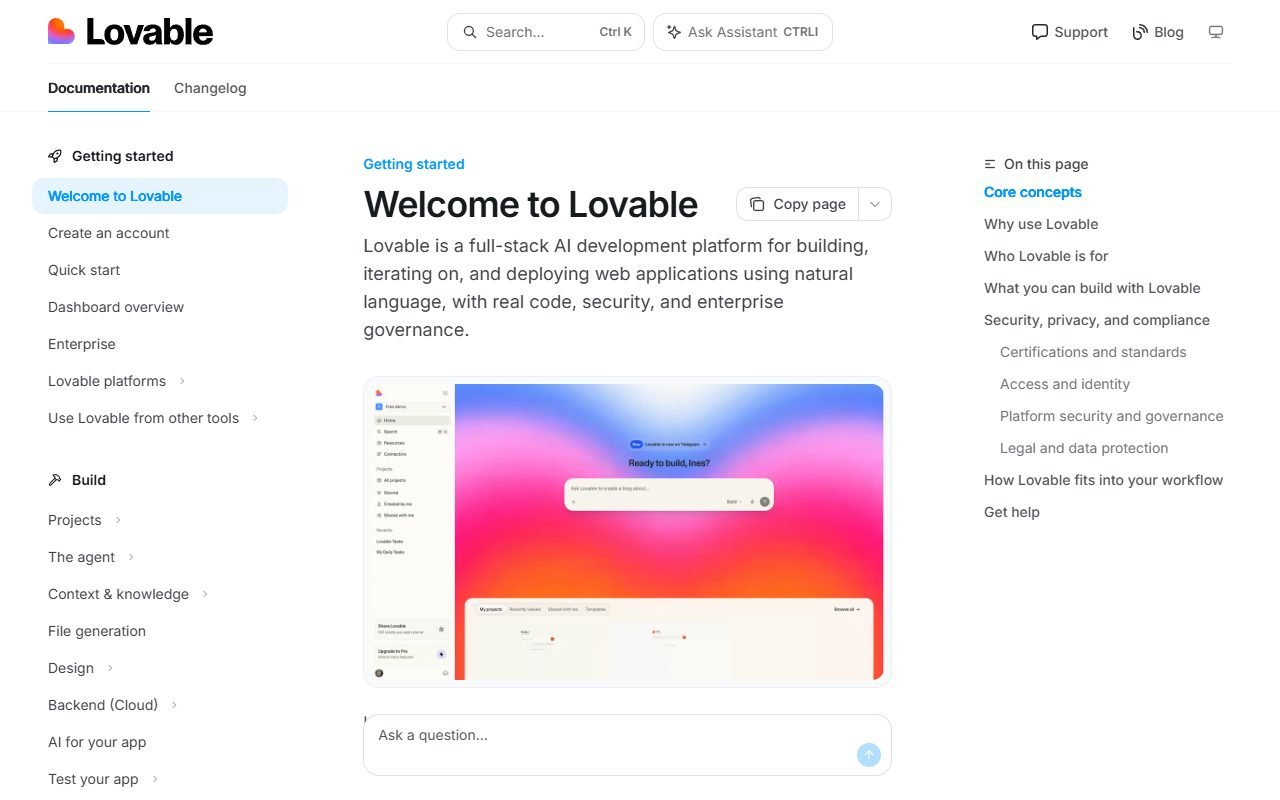
Lovable can create UI and application flow from a prompt, ready to view code/preview and connect to backends such as Supabase. So it's between a no-code builder and an AI coding workspace. The work that hits the right path is MVP, dashboard, client portal and SaaS web app where the team wants the first version quickly but still needs a repository for developers.
It's not a shortcut bypassing requirements engineering. Users still need to clearly specify roles, data rules, failure state, and job acceptance criteria. Prompts that look good but don't specify permissions may create a demo that exposes data to the wrong person.
Core competencies
- chat-driven generation and visual edits for screens
- GitHub integration to sync/export workflow according to documentation
- backend/database/auth via integrations, specifically Supabase and Lovable Cloud as per current scope
- deploy/hosting and custom domain according to plan
- Security scan helps identify certain types of patterns but does not replace manual review.
 Visit Lovable ↗
Price and credit
Pricing is a system of credits per message/task and Free and paid plans. Please check [official pricing] (https://lovable.dev/pricing) on decision day because quotas and features can be changed. The cost that should be measured is the number of prompts until passing the test, not the number of prompts until getting the first page. Backend, hosting, domain and developer review fees are also included.
Ownership, GitHub, and Exit
GitHub sync allows for a clearer code workflow than a closed visual platform, but “having a repo” does not equal moving without work. Teams should clone, install, build, run tests, and deploy outside of Lovable in a clean environment, as well as check dependencies and environment variables before portability is considered passable.
Security
Lovable has security documentation, database security check, 2FA, and compliance information for organizations. The documentation itself specifies schema/RLS checks; This reinforces that generated apps must have correct row-level security. The article does not claim that the provider's SOC 2 automatically makes user apps compliant.
Visit Lovable ↗Consensus from reviews from more than 6 sources.
G2, Product Hunt, Trustpilot, TechRadar, Cybernews, Zapier, Builder.io and trial articles on Medium/Substack Positive reflection on speed from idea to prototype, initial UI usable and working with GitHub/Supabase Repeated warnings include credit consumption, iteration that fixes broken things, debugging for people who don't read code, and security/configuration. Platform reviews and editorial reviews are not the same type of evidence, so ratings are not averaged.
Advantages / Limitations
Pros: Fast first full-stack draft, handoff via Git, easy-to-understand visual + chat workflow, and modern web ecosystem.
Restrictions: Code generated must be reviewed, credit cost depends on the solution, backend policy is the creator's responsibility, and native mobile/self-host boundaries must be evaluated according to requirements.
Select Lovable or Alternative.
Choose Lovable when repository and developer continuation are more important than pure visual logic. Compare Bolt for open browser coding with package/runtime, Base44 for managed backends with minimal setup, and v0 when the primary purpose is UI/component for Next.js teams. Internal links: /compare/lovable-vs-bolt/, /compare/base44-vs-lovable/
Verdict
Consider Lovable for a subcontracted MVP. code/security. Avoid using the prototype to collect real data before passing authorization, dependency, and recovery tests. If the team isn't ready to maintain the code after generating it, a Base44/Bubble managed tool might be more direct, even with the trade-off of lock-in.
Visit Lovable ↗FAQ
Is Lovable free to use?
There is an initial plan under daily/monthly credits and pricing limitations
Do you have the source code?
Documentation supports GitHub workflow but requires experimentation with clone/build/deploy. To confirm the actual solution of the project
Is Lovable safe?
The provider has controls and a scanner, but how secure the generated app is depends on RLS, secrets, dependencies, and testing.
Is it suitable for Thai language?
There has not yet been a comparative experiment with the same problem in terms of commands, characters, searches, and Thai text generated by the system. The status is therefore not yet confirmed.
Resources and freshness
The evidence used here was checked on 2026-08-01. Recheck credits and pricing before buying. For a long-lived app, also confirm current documentation, code rights, and security requirements after relevant product changes.
Workflow from Prompt to Repository that the team can take over.
Start with a product brief of no more than one page: roles, routes, data entities, acceptance tests, and anything not to be changed. Have Lovable propose a plan and create an initial branch, then connect to GitHub before the big iteration so that every change has a detectable diff. Commanding “make it prettier” without specifying component/viewport makes it impossible to evaluate; Change one requirement at a time and run the regression every time.
For the CRM fixture, test signup, owner/staff permissions, create/edit/delete, search 1000 records, and failed API response. When connecting to Supabase, open RLS before entering data, and use account role B to directly open role A's URL. If the UI page is hidden but the API still returns data, it is considered a failure.
Feature-by-feature context
| ability | help with anything | Limitations that must be checked |
|---|---|---|
| Chat generation | Create multiple files from requirements | context drift and regression |
| Visual edits | Edit the layout without starting a new prompt. | precision, breakpoints and code cleanliness |
| GitHub | There is a version/handoff workflow according to docs | sync conflict, clean build and rollback |
| Supabase/Cloud | Reduce setup auth/database | RLS, migration, region and cost |
| Security scan | Point out schema/RLS pattern according to security docs | It is not a penetration test or compliance guarantee. |
Pricing and TCO
| cost | Evaluation method |
|---|---|
| Lovable credits | Measured per accepted story, not per prompt. |
| Backend/hosting | Separate dev, staging, production, and egress. |
| Git/developer review | Count the time to check diff, test and dependency. |
| Incident recovery | Experiment with revert commit, restore data, and rotate secret. |
| Migration | clean clone/build/deploy in new account |
The Lovable pricing page is the only source for the current credit amount. External reviews that post previous numbers are used only as historical context. Remaining credits are not valued if the agent uses multiple messages to resolve the original regression.
Privacy, ownership and export boundary
Syncing GitHub improves code visibility, but not all data, secrets, deployment configuration, and third-party services are in the repository. Exit checklist must include database dump/migrations, object storage, DNS, auth callback, and environment variables. Read Lovable and Supabase's Terms/Privacy by processor role; Do not write “Own everything” without legal verification.
Decision matrix
| Requirement | Basic Fit |
|---|---|
| Website MVP that the dev team takes over | High when Git/clean build passes |
| Founder doesn't read code at all. | moderate; debugging/security is a burden |
| Native mobile | Must compare specific outputs |
| Self-host frontend | Worth trying through the repo. |
| Regulated/sensitive data | Additional safety and legal inspections are required. |
| Marketing page only | v0/Framer might be more concise. |
Positive and dissent reviews
TechRadar explains CRM-style app creation and visual editing, while G2/Product Hunt emphasizes speed and control via voice code in Trustpilot/community. Warning about support credits and fixes that create regressions. CVE/database issues that were previously reported as a reason to add RLS testing are not a reason to say that all Lovable apps are not safe.
Additional FAQs
Can a visual editor replace all code editing?
It should not be expected that logic, dependency, data migration, and edge case tasks still require code/test reading.
GitHub sync means no lock-in, right?
Helps reduce risk But you must prove that the build/deploy and services can be fully assembled and moved.
Is Security scan enough?
No, Scanner is a layer of guardrail, requiring authorization tests, dependency/secret scan and review by the responsible person.
External review sources used in this synthesis
These links represent external reviewers or users, not PickByTask endorsements. Read them alongside official facts, checked dates, and any conflicting evidence.