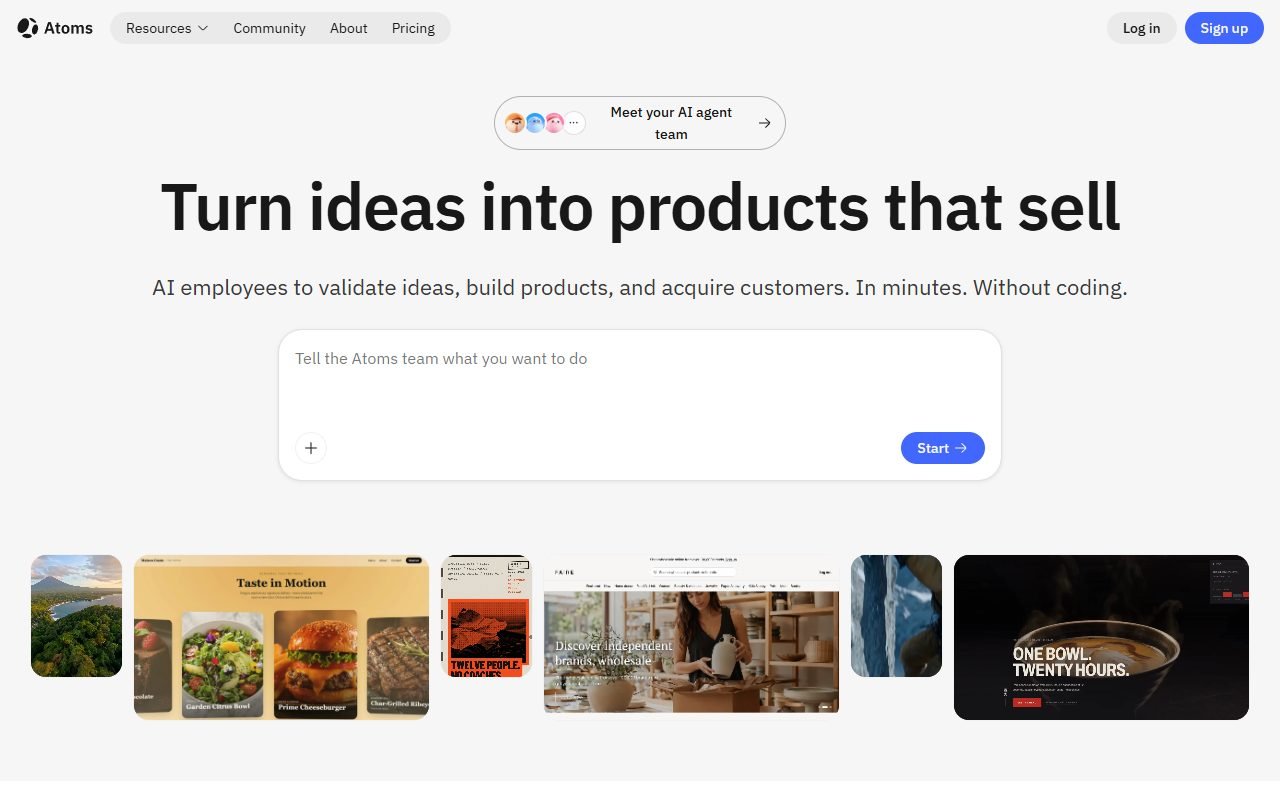
Atoms.dev is a candidate for solo founders who want AI support across research, product planning, coding, and launch. It divides work among multiple agents and offers code download on eligible plans, but the number of agents does not establish the quality of the resulting app.
Check credits, cloud costs, and how you would maintain the downloaded code. The evidence recorded on 1 August 2026 includes only five substantive independent review sources, and PickByTask has not tested the product. Treat it as a candidate to evaluate before committing.
Contents — jump to a section
What do Atoms do?
The official use case page explains that instead of having a single agent, Atoms divides work into roles such as product, architecture, engineering, SEO, and analytics, then creates previews for users to edit via chat or visual editor. This approach is interesting when the idea owner needs both product and launch framework, but “multiple agents” doesn't automatically confirm better architecture or code quality.
Ideal applications include SaaS prototypes, portals, dashboards, and marketing sites that accept a managed workflow. Work with compliance, critical transaction, or native-mobile requirements should undergo a separate technical review.
Price, Credit and Cloud
Pricing page as of August 1, 2026 shows Free with credit and limited space, Pro starting at $20/month and Max starting at $100/month with smaller credit tiers. Some of the same page renders the $0 number on the card before the FAQ explains the actual price. So save it as a presentation conflict and use the FAQ as a careful explanation.
Generation credit and Cloud/AI runtime costs are different dimensions, so users should create a cost scenario: initial build, number of revisions, traffic, storage, and external model/API. “Starting at $20” should not be assumed to cover the total app cost.
 Visit Atoms ↗
Code, deployment and ownership
The pricing page specifies download projects in the paid plan and Atoms Production Cloud, but we need to test what can be downloaded, whether they have complete build/run instructions, and how easily they can be moved to another host without relying on a specific service. Terms specify the service provider as MetaGPT LLC; The team must read the rights to input/output, acceptable use, termination and export before using important information.
Security that must be proven
Privacy Policy explains data processing and transfer. But this is not evidence that the generated app has the correct permissions set. The test plan must check for auth, row-level access, secrets, dependency scan, log, backup, and account deletion, separating platform security from generated-app security.
Voices from external reviews and evidence gaps
Vibe Coding Intel, MakerStack, Substack review, Trustpilot, and discussion on Reddit paint a positive picture of first build, multi-agent workflow, and founder fit. Meanwhile, there are questions about credits, cloud costs, multiple code revisions, and support. We found only five independent sources for signals; Post launches or comparisons written by Atoms themselves are not counted as external reviews, so there are still gaps in external evidence.
Visit Atoms ↗Advantages and limitations
Worth to consider: Workflow spans multiple tiers, includes visual editing, free entry, and code download in the paid tier.
Also be careful: Pricing UI has conflicting messages, generation/runtime costs are separate, independent evidence is thin, and no testing results yet. portability/security of PickByTask
Compared to what?
Compare Base44 if you want a business app-focused backend-in-one, Lovable/Bolt if developer handoff and Git workflow are important, and Replit if you want a workspace where you can edit and deploy code yourself. Planned internal links: /compare/base44-vs-atoms/ and /compare/atoms-vs-lovable/.
Verdict
Atoms is a candidate to test, not a recommendation to buy right now. Choose a free trial with a small fixture and a fixed credit budget first. If test results rely on iterative solutions or cloud costs are unpredictable, stop and compare options.
FAQ
Is Atoms free to use?
There is a Free plan subject to credit, space and backend-project limits as per the pricing page.
Can I download the code?
The pricing page states that this feature will be available in Pro/Max, but it still needs to be fully tested and deployed outside the system.
Is it suitable for people who don't code?
You can start with natural language, but examining security, data, and costs still requires someone who understands the system.
Why are the conclusions still so uncertain?
Because there are not yet six independent review sources. And there is no evidence from direct experiments.
Visit Atoms ↗Freshness
The evidence used here was checked on 2026-08-01. Confirm current credits and prices before buying, and check terms, code export, and cloud responsibilities before committing an app to the platform.
Workflow that should be used to evaluate multi-agent
The same brief is given for all tools: the portal accepts requests with Customer/Staff, status workflow, file upload and dashboard. Do not evaluate from the landing page because agents with multiple roles can look impressive without even touching the data constraint. Atoms recommends research and plans for editors to freeze the criteria for accepting work before starting the build. Otherwise, changing scopes between agents makes it impossible to distinguish whether the quality increase is due to reasoning or due to additional credits.
When you get a preview, check the route/data map before looking beautiful. One revision should solve a single requirement and record the diff, credits, and regression. If the system has Race mode, compare it to normal mode with the same prompt, model budget, and criteria. So we can tell whether the additional compute is worth it or not.
Feature-by-feature
| part | What the official page states | Lack of evidence |
|---|---|---|
| AI team | Divide roles product/architecture/engineering/growth | Quality superior to single-agent in the same fixture |
| Theme/visual editor | Adjust your appearance after generation | regression and responsive precision |
| Atoms backend/cloud | Enable backend and production cloud | runtime bill, region, backup and incident path |
| Download project | Available in paid tier according to pricing | clean install/build/deploy outside Atoms |
| Custom domain/team | is in the supported plan | permission and billing governance |
Pricing/TCO table
| list | Information as of 2026-08-01 | How to keep expenses from blooming |
|---|---|---|
| Free | 15 daily credits and “up to 25/month” according to the pricing page, which should be explained | Use only discovery fixtures. |
| Pro | FAQ states starting at $20/month 100 credits | Set maximum iterations |
| Max | FAQ states starting at $100/month 500 credits | Use Race mode when there is a baseline. |
| Cloud/AI runtime | This is a usage amount separate from build credits. | Set budget alert and traffic cap |
| External services | domain, email, payment/model APIs | Separate ledger by vendor |
The card that the search renderer reads is $0, contrary to the FAQ that states the starting price. Therefore, you must check the latest checkout page before displaying the actual amount. This conflict is a reason to display “Check latest official prices” near the CTA.
Privacy, deletion and operational exit
Privacy Policy specifying data transfers to the United States according to the mechanism mentioned But Thai teams storing customer data must consider their own legal base, contracts, and processor chain. Deleting an account does not necessarily equal deleting deployed data or a third-party database. Test export, delete, and log retention separately. The terms at atoms.dev/terms-of-service are a starting point, not legal advice.
Decision matrix
| Situation | Provisional guidance |
|---|---|
| Solo founder exploring a SaaS app | Try a small scope and check free-plan limits. |
| Developer handoff required | Test download and a fresh deployment before a long subscription. |
| Sensitive app data | Review security and data-processing evidence with a technical reviewer first. |
| Cloud control required | Compare Replit/Bolt or a stack you deploy yourself. |
| Broad evidence of user experience required | External evidence remains limited; seek more detail before deciding. |
Read reviews without losing selection bias.
A few specialist articles praise multi-agent and monetisation scaffolding, while Trustpilot/Reddit There are both satisfaction and report builds, costs, or questions that the docs didn't fully answer. The first group might have an affiliate incentive; The latter group checked their identity/context unevenly. So we keep it as a theme, not selecting only good messages, and not creating a PickByTask rating.
Additional FAQs
Are app creation credits and Cloud Balance the same?
They should not be combined into one total. The product/community page describes generation and runtime as different consumption paths. You must see the actual billing dashboard.
Does Race mode definitely give better results?
Service provider specified compute/accuracy benefit but must A/B test with the same fixture before finalizing.
Can it be used with Thai customer data?
It shouldn't be until it's checked. Privacy/Terms, processor, location, deletion and security configuration according to organizational context
External review sources used in this synthesis
These links represent external reviewers or users, not PickByTask endorsements. Read them alongside official facts, checked dates, and any conflicting evidence.