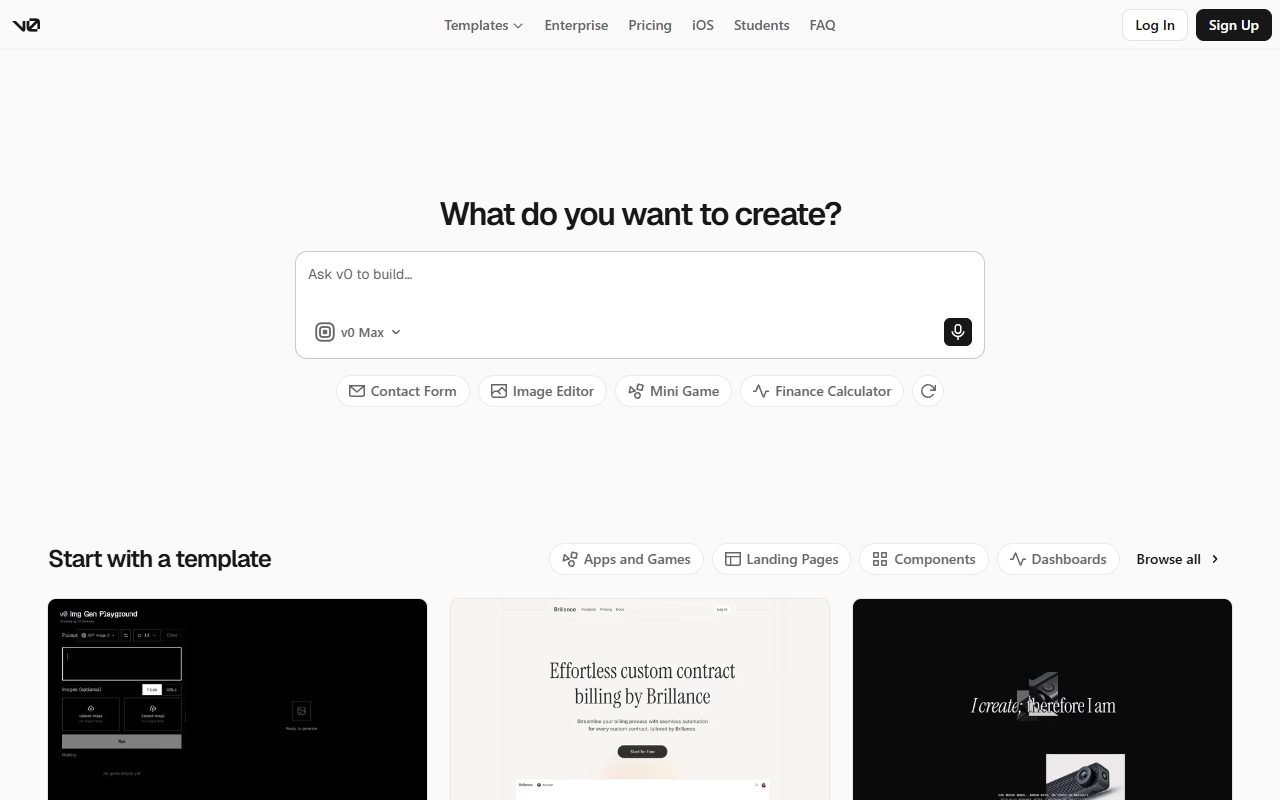
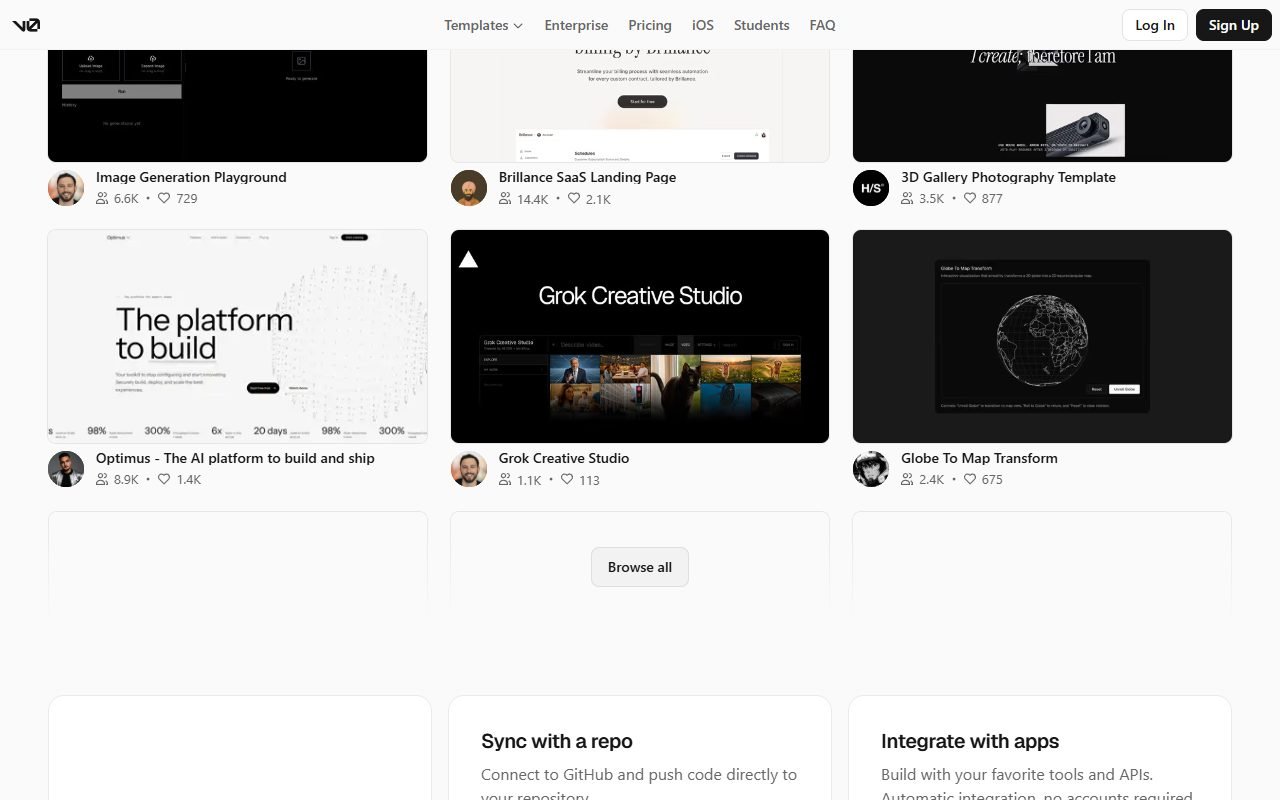
v0 is a candidate for designers and developers starting React or Next.js interfaces and bringing the code into a Git and Vercel workflow. Evaluate a component, dashboard, or frontend flow that a development team will maintain.
Check credits, framework assumptions, accessibility, and backend security separately. A working first screen does not establish that the app is ready for real use. The information was checked on 1 August 2026; PickByTask has not tested the product.
Contents — jump to a section
Ideal job
Starting a component, dashboard, landing, or frontend flow that the dev team will take over does not guarantee a full production stack from a single prompt.
Code workflow
Check generated files, dependencies, responsive behavior, state/error and repository diff according to docs
 Visit v0 by Vercel ↗
price
pricing Use exchangeable credits/plan, measure per accepted component, includes Vercel hosting/backend and developer review.
Deployment
Vercel integration reduces friction, but the repository should be built in clean CI and experiment with other providers if portability is a requirement.
Ownership
Read Vercel/v0 Terms for input/output and generated code; open-source package license must be scanned separately.
Visit v0 by Vercel ↗Security
Check secrets, server/client boundary, auth, dependency, API validation and logs; AI output does not inherit compliance from Vercel.
Accessibility
Run keyboard, focus, label, contrast and screen-reader checks because the UI doesn't look as good as WCAG passes.
review
Product Hunt, G2, Trustpilot/Vercel signals, TechRadar, Zapier, LogRocket, Builder.io and SitePoint praise component quality/speed; dissent are credits, repetitive aesthetics, code cleanup and framework bias.
Workflow Scenario: Accessible SaaS Dashboard
Let v0 create a dashboard with navigation, data table, filter, chart, empty/loading/error states, and modal form with a brief specifying Next.js version, component constraints, keyboard behavior, and viewport from scratch. Select variant from acceptance—not. Just beauty—and submit it to the Git branch.
After generation, developers check semantic HTML, server/client boundaries, data mocking, dependencies, and responsive overflow instead of mock API with fixture endpoint, run unit/component/e2e and accessibility checks, and finally deploy both Vercel and another clean environment to measure ecosystem convenience and portability separately.
Visit v0 by Vercel ↗Generated UI, Code and Project Context
| Layer | benefit | evidence |
|---|---|---|
| Prompt/variants | Explore alternative UIs quickly. | coverage requirements and originality |
| Component code | You can forward the repo. | readability, types, testability, licenses |
| Design system | Use tokens/components that are familiar to the ecosystem. | consistency and no hard-code repetition |
| Git workflow | review/revert via diff | branch/merge conflict and history |
| Vercel deploy | preview/production integration | env, logs, rollback, cost |
| Full-stack additions | Connect data/auth/API according to capability | validation, secrets, RLS and migration |
v0 docs Confirm product workflow as of inspection date, but code quality/accessibility must come from repository evidence.
Pricing/TCO per Accepted Component
| Cost layer | Measurement |
|---|---|
| v0 plan/credits | credit from brief to merged component |
| Model iteration | Visual editing vs. manual code editing |
| Developer review | minute cleanup/types/tests/security |
| Hosting/build | Vercel build/runtime/bandwidth |
| Backend services | database/auth/storage/model APIs |
| Migration | non-Vercel build/deploy and environment inventory |
Check v0 pricing before approving. Do not compare with Replit/Bolt with the price of the plan alone because v0 may send components to the existing workflow. Another tool is integration. workspace/runtime rather than Unit equivalents are fixtures that are merged and deployed through
Review Consensus and Dissent
Product Hunt and developer publications praise the visual first pass and ecosystem fit. LogRocket/Builder.io/SitePoint helps with code structure/integration. G2 and broad comparisons provide user signal, but coverage is newer than older platforms.
Another advantage is that it creates component/dashboard Starts quickly and the code is visible. Limitations include credit iteration, visual sameness, cleanup, Next.js/Tailwind/shadcn assumptions and accessibility that are not guaranteed. Production-ready is therefore blocked until tests pass.
Security, Privacy and Dependency Review
Separate Server/Client Components, keep secret and privileged calls on the server. Check input validation, authorization, CSRF/session, dependency advisories and package licenses. Do not send actual customer data to prompt if account policy/retention has not been reviewed.
Vercel security controls cover the platform in scope, but generated apps also include threat models of code, database, and third-party integration. Check preview URL access and do not use production secrets in public previews.
Ownership, Git and Hosting Independence
Repository visibility helps handoff, but environment variables, project settings, database, blob storage, cron, and domains are on different levels. Exit rehearsal must be built with documented Node/package-manager versions and deployed non-Vercel if requirements require output rights to third-party code. Terms/licenses apply. Do not use the advertising word "complete ownership"
Decision Matrix
| Requirement | Fit |
|---|---|
| UI/component for Next.js team | high |
| Design exploration with code | High when you can review |
| Non-technical full business app | Base44/Lovable might be more direct. |
| Multi-language IDE/runtime | Replit is more appropriate. |
| Browser full-project debugging | Bolt should compare |
| Framework-neutral output | You must assess your assumptions first. |
Advantages/Limitations
Good for handoff and design iteration; Must have a technical owner and is not suitable when framework/hosting is defined differently
choice
Replit for full workspace/deploy, Bolt for browser project, Framer for hosted marketing site link /compare/replit-vs-v0/
Definition of Done for Generated Component
Component passes when types/lint/tests/build has zero errors, no personal secret or mock data, keyboard/focus/screen reader can use main flow, layout supports long Thai text and 390–1440px, loading/empty/error state is visible, and dependency/license Storybook or visual regression snapshots are approved. Important states should be recorded to prevent the next prompt from ruining the original.
If the team has to rewrite most of the component after generation, save that time. v0 isn't considered a time saver because first screenshots are released quickly. On the other hand, if the code passes review by fixing only the copy/data wiring, it's evidence of fit that can be compared fairly with Replit/Bolt.
Additional FAQs
Is v0 suitable for people who don't code?
Prompts can be started, but merge, data/auth, tests, security, and production operations still require a technical owner.
Can I use the code outside of Vercel?
You must clone/build/deploy with the target environment. Having source helps but does not guarantee that all service dependencies have been migrated.
Is the UI created through accessibility standards?
It should not be assumed that every component of the keyboard, focus, labels, contrast, semantics and screen reader must be checked.
Can v0 be used to create a design system?
Can help draft components/tokens, but governance, naming, documentation, versioning and compatibility There must also be an owner of the design system.
FAQ
There is an entry plan according to pricing; get code according to workflow; There is no limit to whether the code is safe/accessible; Thai copy still needs to test