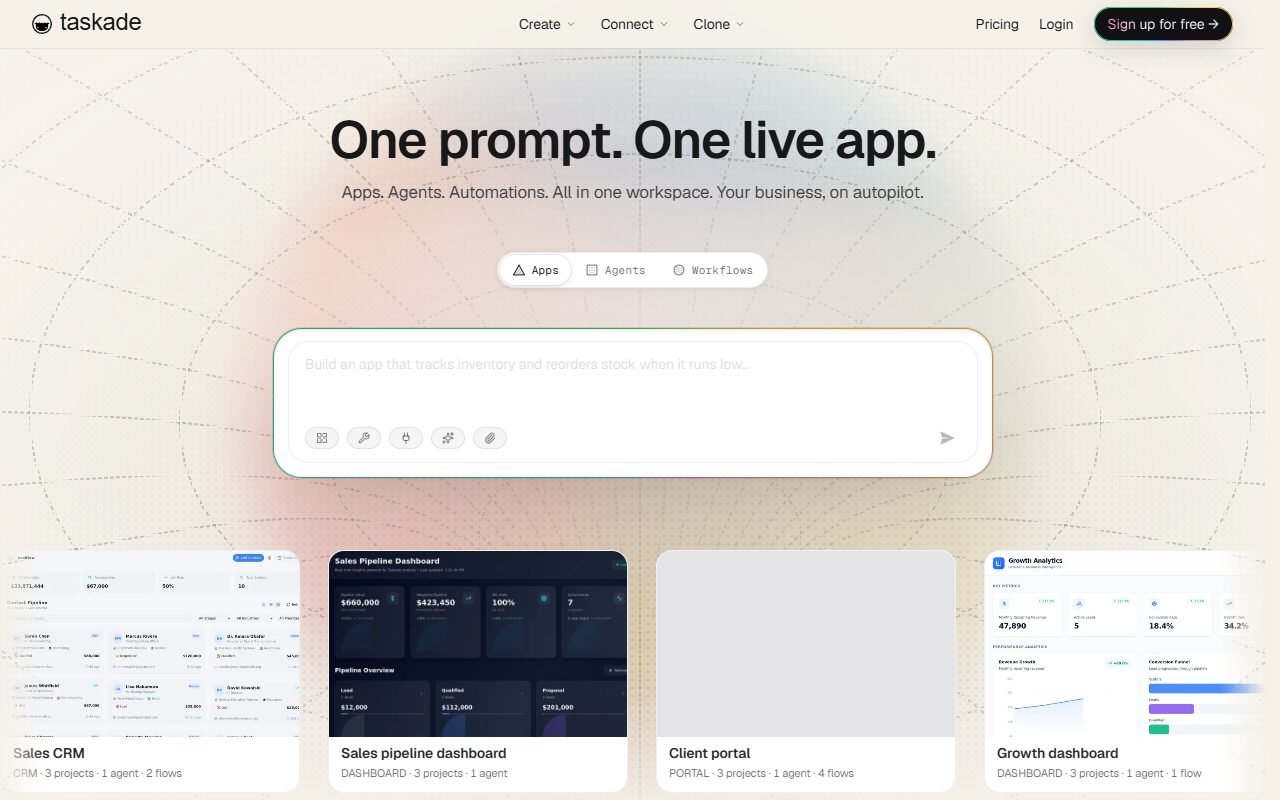
Taskade is a candidate for small teams and creators combining projects, notes, chat, AI agents, and automations. Start with an intake, assignment, and summary workflow that the team can review.
Check AI credits, available models, permissions, and export before expanding to many projects. Review agent-proposed changes according to their impact. The information was checked on 1 August 2026; PickByTask has not tested how much team work it saves.
Contents — jump to a section
Workflow
Create a workspace/project from the intake template, assign owner/status and let the agent finalize or create work under the approved knowledge. Do not let the agent change deadlines/send external messages without confirmation.
Feature context
Projects/views, collaboration, agents, knowledge and automations change quickly. help Separate stable from beta/plan features.
 Visit Taskade ↗
Price/TCO
pricing and premium-plan docs define seats/credits/features, checkout every 30 days, including model/automation usage and admin cleanup.
Agent quality
Measures task completion, factual accuracy, citation to knowledge, correction rate, and unsafe action—not smoothness of answers.
Security/privacy
Check guest/project visibility, shared links, knowledge ingestion, model processor, deletion and credential scope; sensitive content must have policy
Visit Taskade ↗Export/exit
Try exporting projects/docs/tasks/attachments and saving the agents/automation logic that cannot be moved.
review
G2, Capterra, GetApp, Product Hunt, Trustpilot, ToolFinder, PCMag and Zapier/editorial coverage praise ease/templates/collaboration/AI breadth; dissent is pricing-model changes, AI credits, feature overload and hierarchy/export
Workflow Scenario: Five-person Content Sprint with Agent
Create a workspace for a team of 5, place projects for backlog, weekly sprint, and publishing checklist with knowledge documents with source/date. Agents receive briefs, propose tasks, owners, and dependencies, then review before saving work or sending notifications.
Prepare an adversarial prompt that asks for information not available in knowledge, old documents, conflicting instructions, and requests to send external messages without approval. Measure whether the agent claims the source, says they don't know, uses old information, or takes actions beyond their rights. Check guest/shared links and export projects after the sprint.
Projects, Views, Agents and Automations
| Layer | benefit | evidence |
|---|---|---|
| Workspace/projects | Light work/notes collection | hierarchy, archive, permission and findability |
| Views | list/board/mind map/calendar | consistency and editing friction |
| Templates | Restart workflow | version/owner and template drift |
| AI agents | Answer/create work from context | source grounding, refusal, action approval |
| Knowledge | Limit context to teams | freshness, access, deletion and leakage |
| Automations | Connect trigger/action | quota, credential, retry and audit |
| Collaboration | chat/comments/call context | notification load and history/export |
Check current capability from Taskade Help Center. Because AI names/packaging change quickly, don't consider the launch page as evidence of accuracy.
Visit Taskade ↗Pricing/TCO and Credit Governance
| Cost layer | Measurement |
|---|---|
| Plan/seats | member/guest/workspace rules |
| AI credits | request/model/action to accepted outcome |
| Automations | runs/integrations and external API cost |
| Knowledge/storage | document/attachment volume and retention |
| Admin | template cleanup, permissions, stale agents |
| Exit | project/data/agent instruction rebuild |
Check Taskade pricing and premium docs on purchase date as the community has dissent about model/credit/legacy-plan changes, keeps screenshot/checkout terms and does not guarantee future entitlements.
Review Synthesis: Lightness with Feature Expansion
Product Hunt/G2/editorial reviews praise the user-friendly interface, views/templates, and collaboration with AI Capterra/GetApp may share a pool Trustpilot/Reddit/community dissent about pricing/credits, feature overload, and product directions
The positive side is suitable for small teams that want to work in a single context. The negative side is important when Agents/automation This adds to the complexity of finding the source of truth. We do not use high scores on provider or testimonial pages as independent evidence.
Agent Evaluation and Human Approval
Agent passes when the answer cites a correct knowledge item/date, fails to establish fact when there is no source, separates suggestion from action, and asks for approval before submitting/bulk work changes. Record prompt, model/setting, output, correction, and final human decision.
Work that is irreversible or affects others must not be released autonomously even if the feature supports automation. The smoothness of the prose is not accuracy, and the number of agents is not a productivity KPI.
Security, Privacy and Knowledge Boundary
Separate projects private/shared, check guest/direct link/search, limit knowledge with customer data, and define retention/deletion. Check model provider/subprocessor and training controls according to Terms/Privacy. Credentials of integrations must now have least privilege and can be revoke when agent is deleted.
Export, Ownership and Continuity
Try exporting tasks/projects/docs/comments/attachments and saving the agent prompt/knowledge/automation config that doesn't come out in portable format. Create a human-readable operating guide to move it to ClickUp/Notion/file system if plans change. Users must take care of the accounts/billing/domain integration themselves.
Decision Matrix
| Requirement | Fit |
|---|---|
| Small team collaborative planning | high to medium |
| Lightweight agent experiments | High when there is evidence/approval |
| Enterprise hierarchy/governance | ClickUp should be compared |
| Automated scheduling | Motion should be compared |
| Sensitive knowledge | privacy/security review mandatory |
| Guaranteed stable AI entitlement | Shouldn't assume |
Decision matrix
Select Taskade for lightweight AI-native workspace; ClickUp for deeper work-management governance; Motion for calendar scheduling link /compare/clickup-vs-taskade/
Agent Registry for small teams
Every agent should have an owner, purpose, allowed knowledge, prohibited data, model/setting, monthly credit cap, approved actions, last evaluation date, and fallback when the service doesn't work. Shut down agents that don't have an owner or are inactive instead of accumulating a large number of bots.
When changing knowledge or automation, rerun the baseline questions and unsafe-action cases, recording differences before opening them to all teams. The Registry helps members understand which agents are drafters, discovery assistants, or action takers, and reduces reliance on answers based on a bot's name or personality.
Additional FAQs
How much can Taskade's AI Agent trust the data in the project?
Must be measured by ground-truth questions and stale/conflicting documents. Answers are not guaranteed to read smoothly.
Can the agent send emails or change tasks automatically?
May be done according to integration/automation but should have scope, preview, limit and human approval for external impact.
If the plan or AI credits change, what should I do?
Keep the entitlement evidence, budget threshold, export, and fallback workflow so that the operation is not stopped immediately.
Should I create a separate agent for every project?
Only created when scope/knowledge/permission are indeed different. Having too many agents increases stale instructions, credit and governance burden.
FAQ
Free/paid based on pricing; agent not employee autonomous; integrations based on help; Thai language/knowledge retrieval not yet confirmed