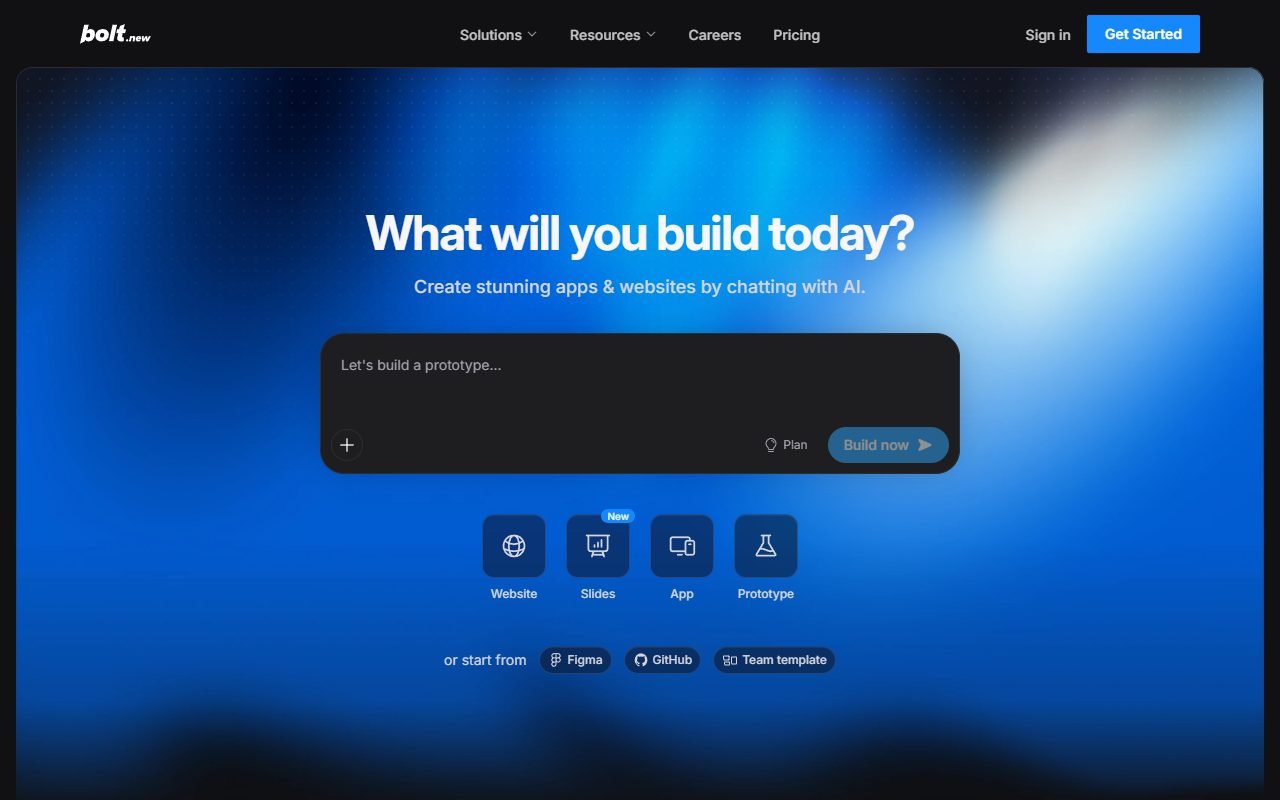
StackBlitz's Bolt.new is a candidate for developers building JavaScript web prototypes who want code, a terminal, and a preview in one browser. WebContainers and the connected development tools make the build process visible, but someone still needs to review and maintain the code.
Allow for token costs, package compatibility, and time spent recovering failed builds. The information was checked on 1 August 2026; PickByTask has not tested the product. Evaluate both a working path and recovery from an error.
Contents — jump to a section
How does Bolt work?
The user tells the agent what they want, creates files, installs packages, runs the development server, and previews them in the browser workspace. This approach provides more technical visibility than a closed no-code builder and is faster than starting with an empty repository. It's ideal for landing pages, dashboards, CRUD prototypes, and integration demos in the JavaScript ecosystem.
Preview success does not equal production readiness; build, environment variables, authentication, database migration, accessibility, and deployment logs must be checked separately.
Core competencies and boundaries
- code generation/editing Multiple files with terminal and preview
- WebContainers runs Node.js tooling in the browser under compatibility constraints.
- GitHub integration and download/export workflow according to docs
- Bolt Cloud/Netlify and database integrations as per current options
- token-based AI usage that increases based on context and iteration
 Visit Bolt ↗
Token price and cost
pricing page has Free and paid tiers based on token allowance; Numbers and packages can be changed so you must check the date of purchase. Complex work uses a lot of context and solving errors may consume tokens without adding additional features. Measure cost per accepted fixture plus hosting/database costs. It's not just a membership price.
Code ownership, deployment and security
Seeing the code and sync repository helps with the handoff, but you still need to check the terms regarding input/output and accompanying services. Before you can move, clone on a clean machine, run lockfile/test/build and deploy to another destination. Secrets must be in the environment, not written to the client; generated dependency and auth policy must be scanned/reviewed.
External reviews
Product Hunt, G2, Trustpilot, TechRadar, Zapier, Builder.io, LogRocket and community comparisons praised the trail. prompt-to-running-preview, browser workspace, and prototype speed. Repeated complaints include token exhaustion, agent loops, context drops, and incompatibility of some packages. This sounds like directional evidence—not performance benchmark.
Visit Bolt ↗Test Workflow: From Brief to Build that the team can accept
Use the same brief as Lovable: a request tracking system that includes Customer and Staff, authentication, CRUD, file attachments, dashboard, and external API. Start by having Bolt describe the architecture and a list of files before allowing package installation, then commit the baseline to Git so you can look back and see what changes were made at each prompt.
Round one measures time to preview but does not rate success. In the second round, add authorization and error states. In the third, disable the mock API to inspect timeout and retry behavior alongside the message shown to the user. Finally, clone the repository onto a clean machine, run install, test, and build, then deploy without using the original session. If the preview works but the clean build fails, classify it as a prototype that requires developer recovery.
The recording should include a token before and after the prompt, the minute the person edited it, the number of files changed, broken tests, and the reason for reversing the commit. This method can separate the feeling of "fast" from the cost to acceptance.
Feature-by-feature: What helps and what needs to be proven
| part | Benefits to the workflow | Acceptance evidence |
|---|---|---|
| Agent/chat | Edit multiple files from a single requirement | diff matches scope and regression suite via |
| WebContainers | Open the Node toolchain in your browser. | The package/build that the fixture uses is fully functional. |
| Terminal/preview | See errors and results on one page. | The log does not hide failures and can be refreshed regularly. |
| GitHub | Keep the version and forward it to the team. | push/pull/conflict/revert via clean account |
| Cloud/deploy integrations | Reduce the steps to upload the preview to the URL. | environment, logs, custom domain and rollback via |
| Database connectors | Start data/auth quickly | migration, RLS/permission, backup and export via |
Bolt Document is evidence of what capabilities are available in the product. But the results of the fixture must come from a separate test log, not use marketing pages as evidence of performance.
Pricing and TCO that should be calculated
| cost | Units that should be recorded | Risk |
|---|---|---|
| AI plan/tokens | token per accepted story | Long prompt and error loop use quota without adding scope |
| Hosting/build | deploy, bandwidth, build minutes | preview cost does not equal production traffic |
| Database/storage | rows, storage, egress, backup | Connect's free tier may end before the app plan. |
| Human engineering | Min read diff/debug/security | People who don't read the log may cycle through the prompt, which is more expensive than fixing it directly. |
| Exit | Clean build/migration hours | service-specific config is not in all code. |
Check the actual numbers at Bolt pricing on the approval day. Do not lift numbers from reviews, which may use old token models. For comparison, use. “Cost per completed fixture” instead of “tokens per month” because each tool is counted in different units.
Positive reviews and Dissent in each period
Product Hunt and walkthroughs often reflect the discovery phase, with Bolt giving users a quick look at the UI and code, G2 and specialist reviews helping to keep the workflow in mind. Trustpilot/community Suitable for capturing billing, support, or build incidents that cannot be resolved, but is not a representative sample of the entire population.
External feedback points to lower browser setup effort and code visibility that lets technical users intervene. Reported concerns include token consumption, losing context across revisions, and recovering dependency errors. These are reasons to test your own workflow; the reviews use different methods and are not a common benchmark.
Visit Bolt ↗Security and Privacy Checklist
Before entering the actual data, check that the API key is server-side, .env/secret has not been committed, the client bundle has no credentials, auth callback limits origin, and all data mutations. Check roles on the backend. Run dependency audit with manual review of new packages chosen by the agent because packages that are successfully installed are not necessarily optimized or maintained.
StackBlitz's Terms/Privacy is based on account and service data, but the generated app may connect additional Supabase, payment, or model providers, so each one has must maintain its own retention/processor boundary. Opening the public preview requires using simulated data and turning off debug output.
Export, Ownership and Recovery
GitHub/download reduces source-side lock-in risk, but deployment settings, secrets, database, DNS, and service accounts do not all migrate across repositories. Exit rehearsal requires creating a new account, cloning the repo, adding environments from inventory, restoring database dump, and deploying without Bolt Cloud if organizational conditions require provider independence.
Rights in input/output must adhere to the current Terms. Do not write a certification that “Own all the code” because dependency licenses and code that the model creates must pass. legal/technical review separate
Decision Matrix
| Requirement | Basic Fit | reason |
|---|---|---|
| JavaScript web prototype | High when package supports | The browser toolchain and preview live together. |
| Developer handoff | Worth trying. | There is code/Git but must be clean-build. |
| Founder doesn't read code | medium to low | error recovery must understand log |
| Native mobile | Still not directly | A specific stack/tool must be selected and tested. |
| Regulated data | Must add review | generated auth/secret/dependency not guaranteed |
| Self-host requirement | This is only possible when the export stack is complete. | Must practice external deploy |
Strengths and limitations
Strengths: Can see code/terminal, start without setting up a local environment, suitable for JavaScript prototypes, and can forward repo.
Limitations: You must understand errors to stop the loop, token cost is difficult to predict, the browser runtime does not replace every production environment, and AI-generated code requires security review.
Bolt vs. Lovable, Replit and v0
Compare Lovable when wanting a visual/product-first flow, Replit when wanting a broader workspace/runtime/deploy, and v0 when focusing on UI components in Next.js rather than a full project. Internal links: /compare/lovable-vs-bolt/, /compare/bolt-vs-replit/, /ai-tools/v0/
Verdict
Choose to test Bolt when the team wants code visibility and is willing to modify the JavaScript build itself. Avoid releasing live data from preview without dependency, auth, and deployment review. For non-technical founders who don't want to see code, Base44 might be easier to start with.
FAQ
Can Bolt.new be used for free?
There is a free tier under the token and limitations based on current pricing.
Can I download or resend the code?
There is a repository/download workflow, but it should be proven with a clean build and deploy outside of the workspace.
Can you use any package?
It should not be concluded like that. WebContainers and the target environment have a compatibility boundary.
Is it suitable for beginners?
The prompt is easy to start with, but when the build breaks, users who can read logs and code have an advantage.
Freshness
The evidence used here was checked on 2026-08-01. Check current token pricing, WebContainers compatibility, integrations, ownership, and security requirements before choosing the platform.