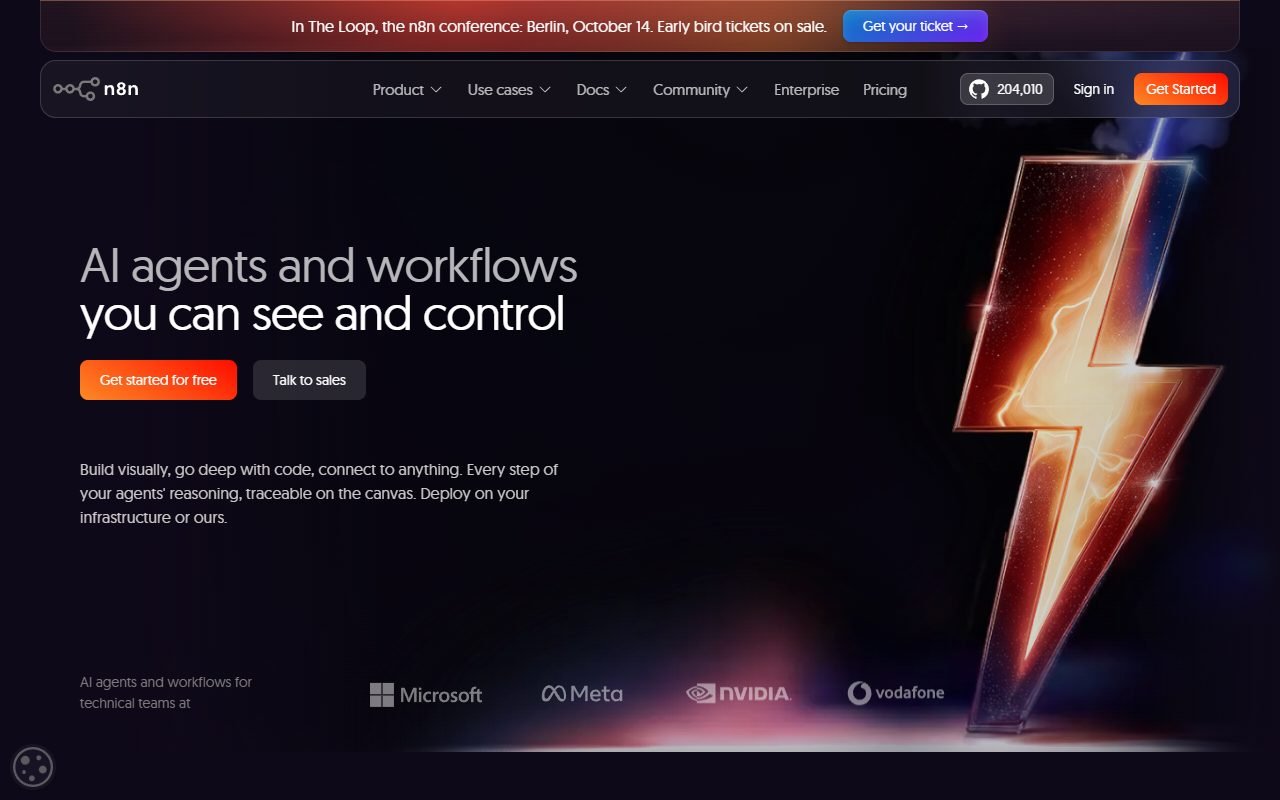
n8n is a candidate for technical teams that want API flexibility, expressions, and the option to host the system themselves. The recorded cloud pricing model counts workflow executions, making actual workload a useful basis for comparison with step-based billing.
Self-hosting adds responsibility for credentials, security, scaling, and the fair-code license. The information dates to 1 August 2026; PickByTask has not run a matched comparison, and current prices need checking before purchase.
Contents — jump to a section
Workflow/feature context
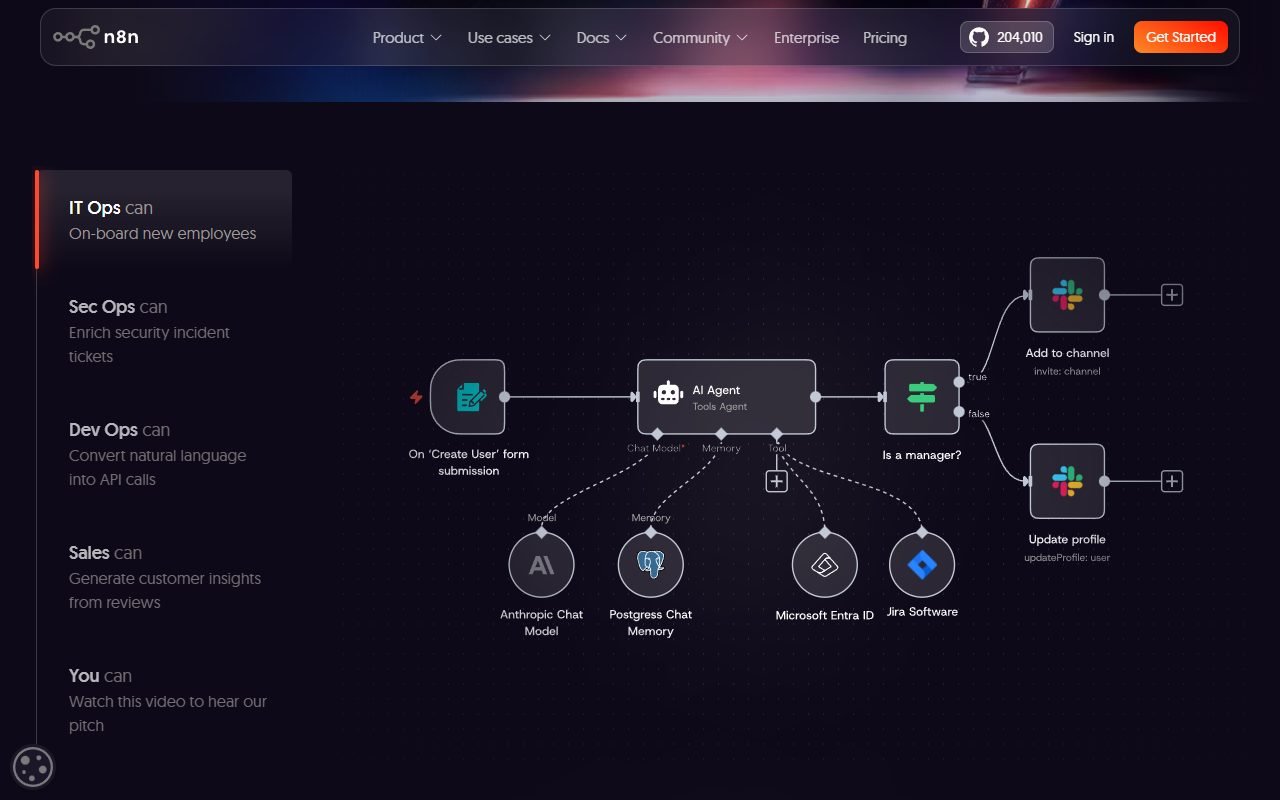
Nodes, branching, loops, code nodes, webhooks and execution history support deep automation. Check connector action/rate limits per system, not judge the number of integrations.
Price/TCO
pricing Show Cloud tiers according to executions/features; self-host Community Edition reduces some subscriptions but adds server, database, queue/scaling, patch, backup and on-call checks every 30 days.
 Visit n8n ↗
License/ownership
n8n uses Sustainable Use License/fair-code according to license docs. Should not call open source without conditions. Check commercial use cases directly.
Security/privacy
Self-host gives more control but administrators must patch, TLS, SSO/roles, secret encryption, database/backup and log retention Cloud checks DPA/region/roles according to plan.
Reliability
Tests retry, idempotency, concurrency, queue, partial failure and credential rotation with recovery runbook.
Visit n8n ↗External reviews
G2, Capterra, GetApp, Software Advice, Product Hunt, Trustpilot, TechRadar and ToolFinder praised flexibility/code/self-host; dissent was learning/setup, pricing changes, scaling and support excluded rating and reduced Gartner shared pool.
Workflow Scenario: Lead Pipeline same as Make/Zapier
Receive 1,000 webhook events, check schema/duplicate ID, enrich via API, route by country, upsert CRM and send notifications. Use code node to only normalize normal nodes that are not normally clear to measure how flexible maintenance is. Set up separate error workflows for 429/500 and dead-letter review.
Run both n8n Cloud and the self-host fixture with the recorded specs, fire duplicate/out-of-order events, restart instance during execution, revoke credential, and restore database from backup. End when CRM/notification results reconcile with no duplicate data, not when the canvas is first green.
Nodes, Expressions, Code and Execution Model
| part | value | evidence |
|---|---|---|
| Trigger/webhook | Get event/schedule | auth/signature, duplicate, concurrency |
| Nodes | Connect app/API | action/version/rate-limit coverage |
| Expressions | map/transform value | type/null/date/timezone correctness |
| Code node | Add specific logic | tests, sandbox/security, maintainability |
| Sub-workflows | reuse and divide the system | input/output contract, version impact |
| Execution history | debug/replay | retention, redaction, partial retry |
| Queue/workers | scale self-host | database/Redis requirements according current architecture |
Use the n8n documentation to check the requirements of your chosen deployment. Queue or database components should follow the workload and scaling needs you have established, rather than being added by default.
Cloud Pricing vs Self-host TCO
| Layer | Cloud | Self-host |
|---|---|---|
| Subscription | executions/features according to pricing | Community/paid features according to license/plan |
| Compute/database | provider manages the service scope | Pay and care team server/database/storage |
| Patching | provider platform | Release/security/migration tracking team |
| Backup/restore | Check plan/SLA | The team designed and practiced it themselves. |
| Scaling | tier/limits | workers/concurrency/queue/observability |
| On-call | support according to plan | The incident response team is full. |
The term self-host free is therefore not a TCO. In summary, admin hours, monitoring, patch, backup and incident must be counted along with license eligibility. Check Cloud execution definition and self-host commercial terms every 30–90 days.
Visit n8n ↗License: Fair-code is not the same word as Open Source.
Sustainable Use License allows use/editing within specified limits and has limitations on providing certain services. The article uses the word fair-code and links to the document. Not construed as commercial use in all cases. Organizations that are embedded/resell/host The customer must request legal/provider clarification
Review Consensus and dissatisfied voices
Product Hunt/G2/editorial reviews praise flexibility, code escape hatch and self-host options. Gartner pools add business user imagery, while Trustpilot/Reddit-type signals warn of setup, support and pricing/license changes.
Opinions that it's worth it often come from teams with ops skill or volume where the execution model has an advantage. Complaints reflect that more control can turn into a burden. We therefore compare with fixtures and fully loaded TCO, not using the lowest server value or average star.
Security Hardening for Self-host
Set TLS/reverse proxy, admin access, MFA/SSO according to edition, encryption key, database credentials, execution-data retention, backup encryption, network egress and update cadence. Close public editor and separate webhook endpoint according to threat model. Test restore with encryption key stored outside the instance.
Credentials of apps must have least privilege/rotate Code/community nodes must review source/version Community nodes increase supply-chain risk; Do not install because the name is close to the app without checking the administrator.
Export, Versioning, and Disaster Recovery
Stores workflow JSON, environment mapping, credential references, custom code tests, n8n version and dependency/community-node versions. Workflow export does not include all secrets/database/execution history. Recovery test requires creation of a new instance, import workflows, restore database/keys and replay synthetic event.
Decision Matrix
| Requirement | Fit |
|---|---|
| Technical API automation | high |
| Self-host/data control | High when there is an ops owner |
| Non-technical simple SaaS linking | Zapier might be easier |
| Visual complex SaaS without infra | Make should be compared |
| Resell/embedded automation | Must check license and legal requirements. |
| High availability | Must architecture/load/recovery proof |
Decision matrix
Choose n8n when control/code/self-host is worth the ops burden; Make when visual SaaS depth; Zapier when ease/app coverage links /compare/make-vs-n8n/
Additional FAQs
Is n8n open source?
The code is open for viewing/use under the Sustainable Use License, but should not be called open source unconditionally. Read the license for actual use cases.
Do self-hosts need to use Redis?
Depending on the current deployment/concurrency architecture, components should not be added until load/reliability requirements justify their necessity.
Are community nodes safe?
Not certified by the marketplace name. Must check publisher, source, permissions, updates and dependency risk before installing.
Advantages/Limitations
Flexible and inspectable, but not no-maintenance; Community Edition does not achieve feature parity in all aspects
FAQ
There is self-host edition under license; Cloud trial/plan can be changed; The execution model must be viewed at present; AI nodes send data to the model provider according to the config.